Send your opinions, pictures or articles to post: sanpasecblog@hotmail.com

School group on Facebook: http://www.new.facebook.com/home.php#/group.php?gid=30642011272&ref=ts

You can also leave your comments in the different posts!

Showing posts with label Reviews. Show all posts

Sunday, May 3, 2009

The Curious Case Of Benjamin Button

By Julieta Serrano
There are lots of marvellous movies in the world these days, but if you like movies you have to see this one. The Curious Case of Benjamin Button is a movie directed by David Fincher, produced by Paramount Pictures and Warner Bros. In this movie the main characters are Brad Pitt, Clate Blanchett, Tilda Swinton and Jason Flemying. It tells the story of a person that was born as an old man (Brad Pitt) who starts to rejuvenate himself until he dies being a baby.
The story takes place in the twentieth century where the clothes and thoughts of the characters are different from now. But the most important characteristics are the advanced digital effects and the actor’s appearance that makes people doubt about make up or technology.
There is no doubt that technology has been growing for all over the world in the last years and this is shown in movies, especially in this one. There are some great effects that made the spectators jump from their seats because of the sounds, the pictures and the atmosphere represented in the movie.
What if I say that there are more than 200 digital effects in this film? Have you noticed every change of appearance or when a scene starts or finishes? That’s because digital effects can make everything possible, and this movie has excellent effects, but of course this is not all. The theme, the characters, the atmosphere and the story itself made this movie interesting in all senses.
To add, this film gives good lessons and teaches about our existence, the eternity of love, the importance of a friendship and happiness. When you finish watching this movie you feel like you have just woken up from an eternal dream, so it doesn’t seem like you were in the cinema with your friends.
I would recommend this movie to adults and adolescents, first of all because they will understand it better than children and it’s a movie that has to be seen by everybody. Secondly, it will make people understand the significance of discrimination and shows how was life in the past.


Tuesday, April 28, 2009

Review: An incredible true story


by Roberto Isasmendi

The SNOW SOCIETY is the definitive book about the survivors of the Andes. The most incredible story ever written. If it was fiction it would be unbelievable. But it’s true and it had happened. This book shows the courage, the strength and the decency of these boys to defeat the mountains, something that seemed to be impossible. But impossible is nothing.
It’s about a plane accident that left a group of young Uruguayan rugby players alone, up there in the Andes, without food or coats. They were not found so they had to spend 72 days on the mountains. Only sixteen of them survived. After those horrible days two of them walked across through the range of mountains and appeared in Chile.
Each survivor gives his testimony in first person and tells how the accident affected their lives and how they live today. In the middle of these chapters the author, Pablo Vierci, talks about the most important moments of this story: the departure from Montevideo; those who didn’t travel because they were late or sick; the accident; the wounded; the avalanche that killed 8 friends; the first expedition to look for help; the organization of the group; the death of their rugby team captain; their relative’s death and dead friends whose bodies they started to eat in order to survive; when they heard on by the radio that the air search was being called off; the finding of the tail (plane); the rescue; the last expedition: a week of walking through very high mountains and a very cold climate; when they found the Chilean farmer that helped them and when they came back home.
Life on the mountain was awful. They slept in the plane’s fuselage that was small, very cold and uncomfortable. They really didn’t sleep at all because they could have freeze, so they kept hugging and pinching themselves to keep the circulation of blood all night long. They also had very few clothes and they drank water by melting the snow with the few sunbeams.
Another big problem they faced was the food. They had only a few chocolates and sweeties that fed them for 4 or 5 days. After that they had nothing to eat, so I think they took the most important decision of their lives: to eat the dead bodies of their friends. First they only ate the muscles but then they realised that their body needed some other nutrients so they started to eat the organs, the bones and the brain also. Some passengers tried to view this as a variation on the rite of Communion as Jesus said: “Those who eat my flesh and drink my blood live in me, and I live in them”. One passenger stated the simple reason behind his decision: "If I had died ... and someone else was sitting here telling you his story, I would be glad I had helped someone to live."
They were a society on the mountain. They had to be smart, to organize themselves, to work as a team and to solve their problems together. They felt they were all the same; they were very affectionate and fraternal and they brought illusion to each other. This worked in base of: TEAM, PERSISTANCE, LOVE, INTELLIGENCE, and the most important, HOPE.
This accident changed their lives completely. After this episode they began their life again. They think they had come back from death.
I really recommend this book to you. It is the best one I’ve ever read. It has changed my life because now I know how important life is. If I have food, clothes, a house and a family I am a rich person, I have the necessary things to live, and the rest depends on me. Because in any moment a plane crashes and you realize everything you had and what have you lost.
It is a book to reflect on, that breaks your heart and makes you see the real value of life.
There were 45 people on board. Only 16 survived and they are:
- Roberto Canessa
- Coche Inciarte
- Daniel Fernández
- Adolfo Strauch
- Moncho Sabella
- Alvaro Mangino
- Gustavo Zerbino
- Javier Methol
- Pedro Algorta
- Carlos Páez
- Roy Harley
- Bobby Francois
- Tintín Vizintín
- Pancho Delgado
- Eduardo Strauch
- Nando Parrado


Sources:
- “La sociedad de la nieve” by Pablo Vierci
- http://www.cinematical.com/
- http://www.borders.com/
- http://www.blogs.clarin.com/

Monday, April 27, 2009

My Favourite Sitcoms

“A situation comedy, usually referred to as a sitcom, is a genre of comedy programs. Most of the sitcoms consist on the same characters in a common place such as a home or workplace”. After a day of school or work, the best thing you can do is lay down on the couch and watch some sitcoms, it’ll cheer you up for sure. What I like most about them is that if you missed one episode you’ll still understand the next one, as the “problem” or situation is usually started and ended in the same episode. Two of my favorite’s sitcoms are “Two and a Half Men” and “The Big Bang Theory”

“The Big Bang Theory” is the newest one. The plot is about two physicists (Leonard and Sheldon) who share the apartment. The sitcom stats when Penny their new neighbor moves next door. The difficulties this two have to relate with people out of their environment creates lots of funny situations. They have two friends: Howard Wolowitz who thinks he is like a “god” to women but he is actually very bad with them, and he lives with his mom (who treats him like a little child) and Rajesh Koothrappali who’s actually from India, which makes him feel discriminated by the others, and he feels so intimidated by women that he can’t speak with women unless he is under the effects of alcohol. Sheldon is and feels very superior to the others as he is very intelligent, and thinks he doesn’t need the approval of “inferior” minds. He has “Asperger’s syndrome” which makes him incapable of understanding any facial expressions, he understands everything literately and can’t even understand sarcasm.
“The series contains a lot of gags and references to real physical principles and theories, but clearly they are simplified t
o the maximum to be quickly understood by the audience that has no education in physics, mathematics or engineering”. The show also contains lots of things from “their” world such as Nintendo 64, Xbox, Nintendo WII, Facebook, Halo3, Apple, etc.

“Two and a Half Men” is about Charlie, a single man who lives in Malibu, has lots of money and works little. His life moves around sex, alcohol, gambling and smoking. His peaceful life gets interrupted when his brother Alan who is actually a very polite man moves in with him after getting kicked out of his house by his ex-wife Judith after 12 years of marriage. He moves in with his son, Jake, who is just thinking of food all time or watching TV. Along with them is Berta a very lazy and dominating maid who creates even more conflict to their lives. Besides being very different Alan and Charlie try to create a stable home for Jake and try to help him grow up little by little.

If you like sitcoms or just need a good laugh you should consider watching the series I’ve mentioned before. You can watch all of them in Warner Channel almost every day. They make my day lot better, maybe yours too.

Source of reference: www.wikipedia.com

Guillermo Neme


I’ve stopped waiting for a prince on a white horse…now I’m waiting for a vampire in a shiny Volvo!


Have you ever experienced the need of keep watching a movie? That you don’t want it to end? Or maybe you’re reading a book and you can’t stop because you have to know what comes next!! You’re so interested with the story that you feel whatever the characters are feeling? Don’t worry you’re not a freak!
Thousands of people, including myself, had lived this sort of experiences while watching Twilight and reading the series books. And do you know why?
This love story was written by Stephenie Meyer, an American housewife who once dreamed with a vampire and started writing the book. Not so sure of what to expect she decided to finally publish it in 2005.Fortunately, the story was a huge success! The following year with Twilight leading every list of best sellers, Stephenie wrote its sequel New Moon which is also followed by Eclipse, Breaking Dawn and Midnightsun.
Twilight is a modern love story between a normal teenager and a vampire. Bella Swan has always been different, never caring about fashion or the latest gossip around her Phoenix high school. When her mother remarries and sends Bella to live with her father, she doesn’t expect anything to change. Then she meets the mysterious and gorgeous Edward Cullen, a boy unlike any she's ever met. When Bella discovers what “the pale faces” (Edward’s family) were; it was too late…she was already madly in love with Edward. “Soon they start a passionate and thrilling romance”.But the closer they get; the more difficult for Edward to resist the pull of her scent. But what will Bella and Edward do when the new clan of vampires threatens them to death?
This awesome story continues in New Moon, the second book of the series. After this one Eclipse follows with love problems and the appearance of not only vampires but also other creatures. But the best of all the books, from my point of view, is Breaking Dawn which is the longest of all, but believe me…it’s worth reading!
The movie was released in 2008 with an increasing number of fans all around the world. Apart from the story, what people really love is the movie’s crew. Kristen Stewart plays Bella and Robert Pattinson, Edward. This English guy is the real reason why so many girls love the movie or become interested in the story after watching him on the screen playing a sexy vampire. All the actors involved in the film are now living a sudden success, most of them weren’t known until this huge vampire phenomenon, but now they’re the constant object of looks, photos, cameras and paparazzi.
If I have to give an opinion, I definitely recommend this movie, and the whole Twilight’s series. It’s really incredible the way you laugh, cry, worry and have these sorts of feelings when you’re reading the story and also how Edward dazzles you in the movie. I hope you become interested and read the books or if you prefer watching the movie, with the disadvantage that you’ll have to wait until November when New Moon is released or maybe next year when it comes to our country!

Sunday, April 26, 2009

16 MILLION PEOPLE CANNOT BE WRONG...


There are many good series you can watch nowadays, perhaps to escape stress, to spend your free time, or just to have fun! But Lost is one of the most-watched series, with 5 seasons and at least 2 more to go. It was created by J.J. Abrams, Damon Lindelof, and Jeffrey Lieber and is produced by ABC and Bad Robot productions. It’ s filmed in Oahu (Hawaii) and it was first broadcast September 22nd 2004. Since the First Season, it has been followed by more than 16 million viewers only in USA and has also received many awards, like a Golden Globe and six Emmy awards.

Episodes last approximately 42 minutes and they are usually about one character each (past life, family, relationships, etc.) including flashbacks that sometimes mix with the other character´s life combined with what is happening on the island. When the Third Season is finished, we start watching flashfowards that, combined with flashbacks, make the time something difficult to follow and the series more attractive. The majority of episodes end with a suspenseful event, revealed just seconds before a smash cut to black and the title graphic.

Season’ s summary...


Season 1: Oceanic Flight 815’ s plane crashes on a seemingly deserted tropical island, forcing the group of strangers to work together to stay alive. But there are many strange things in that island such as polar bears, an unseen creature that roams the jungle, and the island's inhabitants known as the "Others". They find a French woman called Danielle Rousseau who has been on the island for 16 years. The survivors also found a mysterious metal hatch buried in the ground.

Season 2: Most of the story, which continues 45 days after the crash, focuses on the conflict between the survivors and the Others. Some mysteries are resolved, and new questions are raised, there are also new characters. The hatch is explored and the existence of The DHARMA Initiative is revealed. As the truth about the mysterious Others begins to unfold, one of the crash survivors betrays his friends, and the cause of the plane crash isrevealed.


Season 3: The story continues 60 days after the crash. New crash survivors and Others are introduced, as the crash survivors learn about the Others and their history on the mysterious island. One of the Others and a new island inhabitant join the survivors while a survivor goes with the Others. A war between the Others and the survivors begins, and a contact with a rescue team is made.


Season 4: The season only lasted 14 episodes because the writers were on strike. This season focuses on the survivors dealing with the arrival of people from a ship, which has come to the Island, and the escape of the Oceanic Six (their post-island lives are shown in flashforwards).


Season 5:Still being aired, it’ s about the 6 survivors who left the island and want to return.


If you want to watch a good series, with action, drama, suspense, all in one... I suggest you should watch Lost.The seriehas very good special efects for science fiction lovers, but it also gives you a lot to think about. If you start watching this serie, I bet it will catch you from the beginning to the end and you won’ t leave it because, can 16 million people just in one country (USA) be wrong?

Sources:

www.envueltosenlibros.com

www.wikipedia.com

www.forodeseries.com.ar

www.taringa.net


GERMAN BECKER

2º Pol.


Wednesday, September 10, 2008

Maturity and redemption

In class we read The Kite Runner, a novel that I loved because it told a very realistic and interesting story which made the readers feel a great variety of feelings. Amir, the character is the one who writes the story, he tells his journey for redemption. We get to know him and in the end he and us learn to forgive himself. The character matures, grows and presents a great evolution through the story. This is what called my attention and that is why I wrote about it.

The Kite Runner is a fascinating novel about friendship, loyalty, guilt and redemption. Amir, the narrator, became obssesed by an event in his childhood that changed his life forever and led him in a journey for redemption, which he finelly gets.
Hassan was supposedly a friend of Amir’s, he was also his servant, they spent all day together playing and learning from each other except when Amir went to school. They shared their childhood, lived in the same house and were breast-fed by the same woman as Amir`s mother had died and Hassan’s had abandoned him. But Amir was jealous of Hassan as Baba (Amir’s father) gave his Hazara servant a lot of attention and accepted him more than he accepted Amir. Because of this and the fact that he was his servant, Amir did not feel Hassan was his true friend, but Hassan did consider Amir as a friend whom he loved and to whom he was extremely loyal. Also, Amir was a Pashtun and Hassan a Hazara which means that the latter belonged to a discriminated part of the society that Pashtuns felt was inferior.
“For you a thousand times over” said by Hassan to Amir, shows his loyalty, admiration and devotion to his friend. He said this the day he was raped by Assef while defending the kite he had run for Amir, the winner of the winter kite tournament. When Hassan was raped that day Amir saw it and did nothing, which marked his consciousness for the rest of his life. “I could step into that alley, stand up for Hassan ... or I could run. In the end I ran”. Since that day he felt guilty and could not take it out of his mind, he could not be in peace with himself.
Around thirty years later, Rahim Khan, and old friend of Baba’s, very special to Amir and a great influence for him, appeared in his life through a phone call telling him “there is a way to be good again” and “true redemption is when guilt leads to good...forgive yourself”. He knew what had happened so many years ago in that alley and what a huge weight that meant to Amir. Those words transmitted hope to Amir and made him talk about that event for the first time in all those years. This pushed him to begin his journey for redemption, in which he rescued Hassan`s child, Sohrab, from Assef. Amir adopted him and took him to live with him and his wife, Soraya. Sohrab was not a happy boy, he had suffered too much and he did not communicate with his new guardians.
At the end of the novel Amir and Sohrab are running kites and at a certain moment Amir offers to run the kite for Sohrab. “For you a thousand times over”, Amir finds himself saying to the child. This reminds us of Hassan’s words to Amir and shows us how the role of Amir has changed and that this is a way of redeeming himself. It seems that now he is on Hassan’s side and he has learnt from him.
That same day Sohrab gives Amir a smile (he had hardly uttered a word) to Amir, “it was only a smile, nothing more ... but I’ll take it. With open arms” says Amir and shows how significant just a smile is for him now, how much he values it. This is important in his journey for redemption; here he shows he has learnt to appreciate little moments in life from Hassan.
Finally, Rahim Khan`s word became true, Amir forgave himself, learnt to live with that mistake and learnt that there was a way to be good again, to be in peace with himself finally, “I ran. A grown man running with a swarm of screaming children. But I didn`t care. I ran with the wind blowing in my face, and a smile as wide as the Valley of Panjsher on my lips. I ran” He feels free, the weight of the guilt he had on his shoulders had disappeared, or was still there but he had learnt to live with it, by forgiving himself.
To conclude, we can see the evolution of Amir’s character in his journey looking for redemption. There are some patterns that appear in two moments of the novel with different connotations that show Amir`s growth. When Amir says “for you a thousand times over” to Sohrab, he shows he has learnt from Hassan’s humility, learnt to value little moments in life as his old friend did. Assef also appears in two moments, he represents evil to Hassan and Sohrab; the first time Amir did not do anything, but the second he knew he would not make the same mistake, he fought Assef, this sacrifice is a way of making up for what he did not do for his friend and in that way he began to redeem himself. Also, the phrase “I ran” is at the beginning and the end of the story with different connotations, at first, it means cowardice, fear, betrayal, and immaturity and finally it means freedom, acceptance, happiness, humility, and growth.
In my opinion, at the end, Amir learnt that Hassan was his true friend but in the past he had not allowed himself to accept him as such because he felt superior, as he was young, immature and confused. When he grows up that changes, he does not feel superior anymore because he has realized and learnt he is not, he accepts his mistake and his situation, learnt to be less strict with himself and to love what he has, Soraya and Sohrab. So the character of Amir evolves throughout the story, he matures and learns to see things from a different and better perspective and in the end he is a happier man.

Monday, May 12, 2008

Review: Shakespeare For Managers


I got Shakespeare for Managers by Rolf Breitenstein as a present and at first I thought it was a book for people interested in being a manager, investor or something related. To my surprise, the book could be read by any ordinary reader who definitely does not have to have any knowledge of Shakespeare or business.
At first the book talks about Shakespeare, his achievements as a playwright, and compares him with today’s investors, economists, CEOs, etc. For example Shakespeare had 10% of the Globe’s income, the theater he worked in, he bought land and properties in different places of England, he risked his career by making different kinds of plays the English were not accustomed to.

Later on there is an analysis of twelve of Shakespeare’s plays which focus on the behaviour of the characters (their characteristics, their strengths and weaknesses), also on the situation each one experiences. This is directly compared with a firm or company where every character plays its role according to their position, e.g. a king is today’s chief executive officer. All of this can be used as a guide or introduction to the business world, and also to Shakespeare’s because you get to know his style, the topics he wrote about which touch on many aspects of life, such as love, hate, death, friendship, doubt,
patience, among others.
In the last few pages there are interesting summaries of his 37 plays (which have no comment on business matters). These are ordered into tragedies and comedies, which are chronologically arranged and the histories, which follow a true historical order; Breitenstein considers that Shakespeare’s plays are too long and summaries are extremely useful, quoting “brevity is the soul of wit”.
There are also three of the most famous speeches “To be or no to be” from Hamlet, “Quality of mercy” from The Merchant of Venice and “All the world’s a stage” from As You Like It. These are very clever speeches, which are written eloquently and have huge power of language, rich in metaphors and other literary devices.
The book is original and practical, also comic, because of the informal analysis, and the alternative endings the author gives to most of the stories. These are usually short; they show that if something or someone had acted differently or if technology had existed in Shakespeare’s plays, the outcome would have been different.
I had never read anything about Shakespeare before, and with just a few lines and phrases it has opened my mind to another world. The whole idea of the book derives from the quote “To buy or not to buy: that is the question”, which summarizes the manager topic with ‘Hamlet’s’ most profound soliloquy. When reading the book, you get to compare different opinions, conclusions and points of view on the same topic, and that way you get a general meaning of Shakespeare’s works.


Pablo Craig

Wednesday, November 21, 2007

Reacción a la Muestra de Bachillerato de Arte 2007

Por Constanza Ellwanger Bossi - 9°A
1. ¿Qué valor tienen las manos para Valentina? ¿La mano de quién está estrangulando al mundo?
Las manos significan muchas cosas para Valentina. Entre esas cosas están la comunicación, la creación, la represión y la prohibición de la expresíón, el amor y el cariño, y la ayuda.
La mano de nosotros mismos está estrangulando al mundo. Nosotros estamos arruinando el mundo, no sólo ambientalmente, pero en distintos problemas y guerras, con la ignorancia y la no aceptación de las diferencias entre nosotros y con la mentira.
2. ¿Qué impresión o impacto te produce el disparo de la AK-47?
Un impacto muy fuerte. Lo primero que pensé fue en la Segunda Guerra Mundial, en como los nazis mataban tan fácilmente a otras personas, luego pensé en el vacío que puede llegar a tener un alma, y el arma reoresentaría la causa de ese vacío, que puede ser un problema cualquiera, pero grave. Más tarde pensé en la discriminación, en cómo una persona (que representase el arma) puede tener un corazón tan frío comom para discriminar y burlarse de alguien sólo por diferencias físicas, culturales, económicas, religiosas, etc. Y también cómo esa "burla" puede dañar al discriminado.
3. ¿A quién ves cuando mirás por el ojo?
Cuando miro por el ojo, veo un lugar vacío, de puertas cerradas, oportunidades rechazadas, una vida tan fría y llena de soledad. Veo también una mente cerrada que no está dispuesta a escuchar o a recibir ningún tipo de ayuda. Una persona aficionada y viciosa, ignorante y egoísta, llena de dolor y sufrimiento y ciega, sin poder notar el "buen camino".
4. ¿Cuántas imágenes ves en el juego de espejos? ¿Qué significan?
Veo muchas imágenes, imágenes que se multiplican cuadno las miro en los espejos. Significan para mí, la población, en un avance constante, multiplicándose con mucha rapidez.

Sunday, September 16, 2007

A2 Language Task


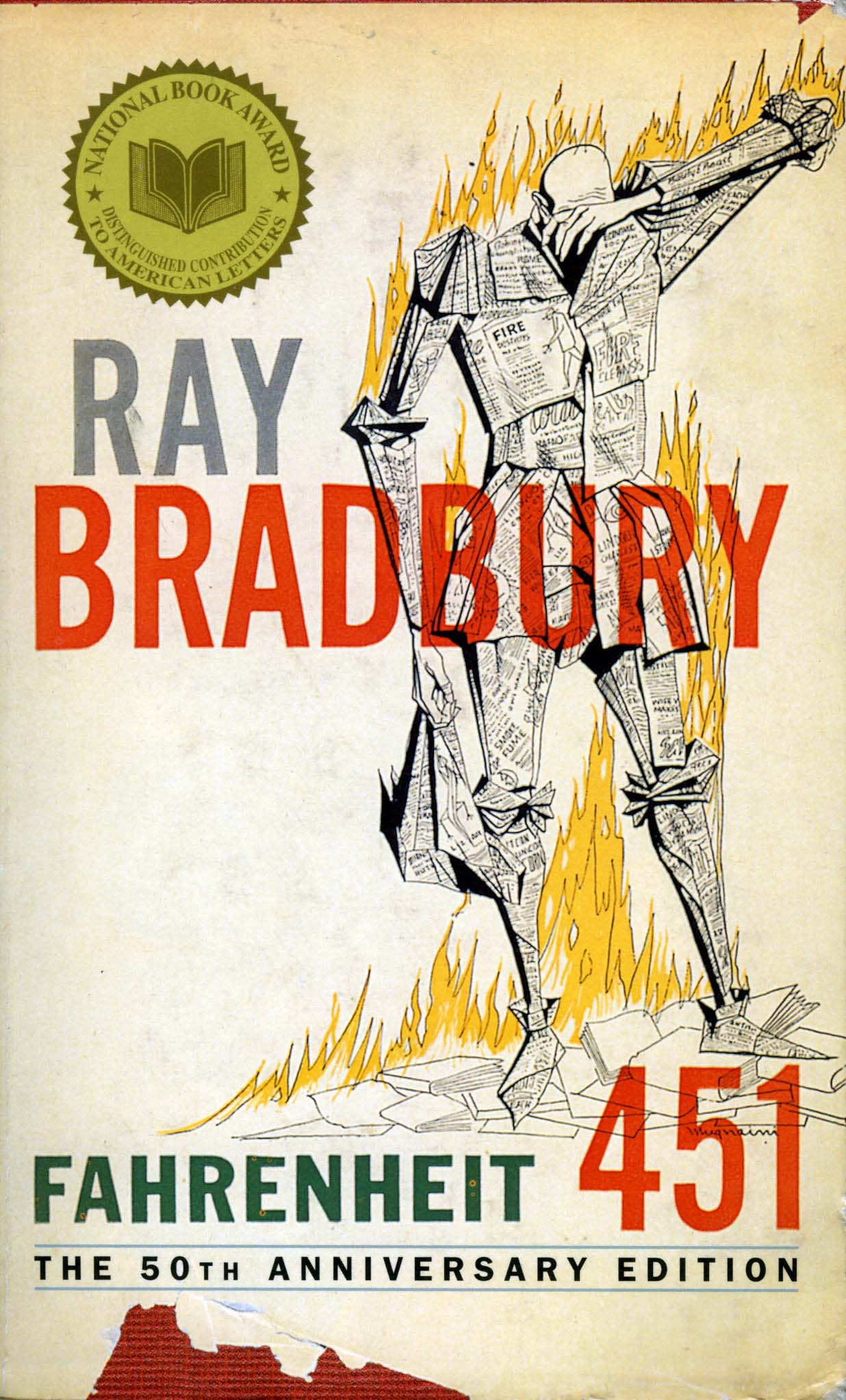
Transcendence in Ray Bradbury’s Fahrenheit 451


At some point of our life, we always question ourselves if we are important for someone else. It is our inner need for transcendence: to live eternally in someone’s mind. In Fahrenheit 451, Montag, the protagonist, has reached this point, and he will change his life in order to leave a personal “touch” in someone or in history.

Montag is a fireman that lived over-controlled in a society where, in order to be happy, everyone had to think the same way, do the same but nothing productive at all, because they did not need to think. They were happy watching non-sense TV the whole day, like Mildred, Montag’s wife, or burning knowledge – books – for a living without knowing their informative and educational purpose, like Montag. Clarisse, a 17-year-old neighbour, said that school “runs us so ragged by the end of the day we can’t do anything but go to bed or head for a Fun Park to bully people around, break windowpanes in the Window Smasher place and wreck cars in the Car Wrecker place…” (p. 37) [1].

The Government encouraged this monotonous life: they did not want people to criticize anything, because it is easier to control ignorant persons than those who think. With people living like that, the social mass believed they were happy, because there were no discussions, no frustrations and so no melancholy. They had no choice of doing something different, but they were happy because they did not conceive a different kind of life.

However, Clarisse affirmed that “…people hurt each other nowadays… They kill each other” (p. 37). Clarisse was one of the few that were aware of and criticized the manipulation of the population. She once said: “’But they all say the same things and nobody says anything different from anyone else’” (p. 38).

Faber, a cynical man[2], had a similar opinion: “(…) ‘the most dangerous enemy of truth and freedom, (is) the solid unmoving cattle of the majority. Oh, God, the terrible tyranny of the majority’” (p. 116). He thought society was oppressive because no one had the freedom to express their personal identity. Everyone had to live a standard life, maybe without their consent. People were like industrially produced: closely the same in every aspect of life.

Montag started to question the meaning of life after meeting Clarisse. He began to think about his future and of what he had done to be remembered after he died. When he thought about Mildred, he felt pity for her because she never did anything in her entire life, neither for herself nor for the community. But when he asked himself what he had done, he realized that he had done nothing:
“(…) ‘poor Millie. I can’t remember anything. I think of her hands but I don’t see them doing anything at all. They just hang there at her sides or they lie there on lap or there’s a cigarette in them, but that’s all.’
Montag turned and glanced back.
What did you give to the city, Montag?
Ashes.
What did the others give to each other?
Nothingness.
(p. 163)

Nevertheless, Montag was not as ignorant as his wife. As a product of a hypnotizing education, Mildred only followed what television said and her opinion was the one that television expresses. She did not need to think, because life was easy. And life being easy meant that people were happy. A person who did not seem pleased would be considered a rebel[3].

Although Montag was brought up in the same way as Mildred, Clarisse changed Montag’s point of view about life. Montag faced reality and wanted a change:
He felt his smile slide away, melt, fold over, and down on itself like a tallow skin (…) Darkness. He was not happy. He was not happy. He said the words to himself. He recognized this as the true state of affairs. He wore his happiness like a mask and the girl (Clarisse) had run off across the lawn with the mask and there was no way of going to knock on her door and ask for it back.(p. 19) (…) ‘Mildred, how would it be if, well, maybe, I quit my job awhile?”(p. 58)

He escaped from his routine. He stopped being a fireman to think, which he does when he relaxes in the river and lets it take him away to a new life. He became aware of the manipulation taking place in society. He wanted to do something to change that situation, and he supposed the solution was in reading books. He felt books contained important information, and that was why they were prohibited.
’I’m going to do something,’ said Montag. ‘I don’t even know what yet, but I’m going to do something big.’ (p. 72) (…) ‘We can’t burn these (books). I want to look at them, at least look at them once. (…) We’ve got to start somewhere here, figuring out why we’re in such a mess, you and the medicine at night, and the car, and me and my work. We’re heading right for the cliff, Millie. ” (p. 73)

Reading books constituted a revolutionary action that had to be counteracted by the burning of the house where books were found. Montag’s house was burnt, and he provoked a huge chaos by killing three persons and destroying a mechanical dog. This caused his persecution by the police; action caught by cameras and broadcast live. He escaped from the chase, even though, the parlours transmitted a wrong image where he was killed. But the victim was a different man. This was done to keep people calm and to show society that they had to follow the rules in order to survive.

The same night after this episode, when Granger told Montag his grandfather’s story, Montag wanted to do something useful so as to be remembered. For example, Clarisse changed Montag’s life in only one week before she disappeared. She made him appreciate life. He started to be curious and made lots of questions. She had touched his life in such a way as to make Montag never forget her.

To be remembered he must do something. He wanted to be like Clarisse, not like Mildred. But his hands had never touched anything; they were working or just dangling meaninglessly. He had “not been there at all”; not living his own life, just obeying the orders he was given:
’I’m not thinking. I’m just doing like I’m told, like always. (…) I didn’t really think of it myself. When do I start working things out on my own?’
‘You’ve started already, by saying what you just said’, said Faber
. ” (p. 100)

When he thought of his life, he became conscious he had been living a monotonous one. Being a fireman was the way the government controlled him, making him do everyday the same activities which he didn’t really enjoy.

The opposite of what Montag had been was Granger’s grandfather, a man who, despite being a common citizen, had been a loved man, till many years after his death. “’He was part of us and when he died, all the actions stopped dead and there was no one to do them just the way he did. He was individual. He was an important man’ said Granger” (p. 163). This man had done something to the world: he worked for his family, played with his grandchildren or helped the community with its necessities. He would eternally live in the mind of people who knew and loved him.

When we talk about posterity, it is in terms of how we have touched other people’s life, which may not always be essentially good. E.g. Captain Beatty was a powerful man that had proved, for us readers, that “Words are like leaves and where they most abound, Much fruit of sense beneath is rarely found’ (p. 114), quoting Pope, and then Dr. Johnson, who said that “He is no wise man that will quit a certainty for an uncertainty” (p. 115). He had read a lot in order to control the subordinate mass and uses his knowledge to manipulate Montag. He thus left a negative mark.

To be remembered we do not need to be the president of the United States, or discover penicillin, or write a novel to win a Pulitzer Prize. “’It doesn’t matter what you do’, Granger’s grandfather said, ‘so long as you change something from the way it was before you touched it into something that’s like you after you take your hand away” (p. 164). We can be remembered by doing simple activities in the way we leave our personal touch on them - also the simplest form of reaching transcendence and a sense of redemption.

.
.

.


Antonieta
.
.
.


[1] Bradbury, Ray (1996). Fahrenheit 451. Great Britain: Harper Collins Publishers.
[2] Faber said: ‘Mr Montag, you are looking at a coward. I saw the way things were going, a long time back. I said nothing. I’m one of the innocents who could have spoken up and out when no one would listen to the “guilty”, but I did not speak and thus became guilty myself’. (p. 89)
[3] For example, having a book at home was prohibited, that was why, when Montag showed his books to Mildred, she “ran forward, seized a book and ran toward the kitchen incinerator” (p. 73). She was afraid of breaking the law, and reacted as she had been taught: burning books.
[5] http://upload.wikimedia.org/wikipedia/commons/thumb/6/69/Ray_Bradbury_(1975)_-cropped-.jpg/488px-Ray_Bradbury_(1975)_-cropped-.jpg

Saturday, August 25, 2007

.· Pearl Harbor ·.

I’ve just finished watching Pearl Harbor and I am shocked… My eyes are still red, my mouth half opened, my heart beats are different from the normal ones.
The film is really good. Great effects, very catching, shows history while showing this love story… I liked it! But the scenes are very shocking. The whole films shows a violent atmosphere, attacks, bombs, everything is very energetic, a lot of movements, screams, and that kind of desperation signals.
I’ve cried several times, and really cried! I still have the image of the burned people, all black, desperately running to the hospital to get some help. The huge mass of people floating on the sea, being filmed by down the water. It’s horrible to see so many legs moving so quickly… You get mad! Then the great masses of fire, of explosions, people being thrown backwards by the bombs, everything burning… People running, screaming, looking to the sky, mouths opened wide, desperation. Only desperation.

I must say that luckily, I didn’t see many children suffering. If that had happened, it would have been really worse. But there are some images that were shown together that really caught my attention – and children are involved.
When the Japanese planes were arriving to Pearl Harbor, minutes before 8 a.m. on December the 7th, we can see people taking up their habitual activities, and watching the planes approaching. We can see this woman (right) tiding up clothes in her garden and a whole lot of planes just passing above her. The woman gets really scared. What would you do, what would you think if that happened to you? Then we can see three little girls playing, dressed as angels, with wings on their costumes, and they also get surprised by these terrible aeroplanes with red circles on their sides. Also we can see in another part, some boys playing, and the planes passing just some meters above them. Those images are terrible!! Poor kids! They don’t know what is going on, what is happening, why are those planes there. They might find it interesting, funny to see 300 planes flying so close to them, but they really don’t understand what is going to come. A great contrast is shown between all these people living normally, doing what they should be doing a Sunday at 8 a.m., and the huge attack about to start. Kids were playing out there, a woman was tiding her clothes, some were sleeping, others working, and seconds later they were all dead! Who could have imagined?
Sunday, June 10, 2007

Thursday, August 23, 2007

"Blood Diamond"


I have just arrived from watching a movie called "Blood Diamond" and I am still shocked, and I truly think that I would be shocked for too many months.
I couldn't help crying during and in the end of the movie, in a way I felt guilty because I do have everything and more than what I need to live, in another way because I do anything to help those people, those KIDS and finally I realized that I cried because it made me realized that all of us don't know a little f*cking thing about anything that is going on somewhere else besides our tiny world.

I do believe in God - I love my God more than anything else in this world because HE never leaves me alone and HE is my faith by which I keep on living and walking through life.
But I have to confess that today I will be the one that judge HIM and ask him WHY DO YOU ABANDON THEM? I have met your grace and your wisdom - I know about your love towards us, your sons - You have showed me that you are real, that you are the greatest thing that WE AS HUMAN BEINGS HAVE.
So, I don't understand HOW ARE PEOPLE KILL EACH OTHER WHILE LIVING IN A SAME COMMUNITY WITH THE SAME RELIGION AND THE SAME STANDARD OF LIVING? WHY ARE CHILDREN KIDNAP AND TRANSFORM INTO SOLDIERS? - WHY DO WE PERMIT THIS TO HAPPEN? - WHY DO YOU PERMIT THIS TO HAPPEN? -


When I was 14 years old I thought that my destiny was to travel to Africa, exactly to the Democratic Republic of Congo, because I felt that I have too many since I was a kid and the children from there haven't have nothing at all since they were born - And they live in such a great and inhuman condition; those who don't have HIV, they have mortal diseases that were defeated in the first world during the Industrial Revolution. Or those kids and adults that die because malnutrition because they don't have even the food to eat at least once a day.
So, then everyone judged me that while my country was also dying because of malnutrition I would left and go to another continent - So I decided to stay and to study and to achieved the knowledge necessary to become a decent politician and help MY nation to become a great nation and solving poverty, injustice and inequality.
But then, today I realized that maybe my dear God doesn't want me here but there. Once He sent me a phase from the bible that claims: "Quiero que se comporten como verdaderos discípulos del Evangelio de Cristo" - This phase has become my destiny, my purpose in life byt which I would march towards my finally meeting with God. The meaning of this phase which is a long written piece gave me the answers to all my doubts about my future, about every single uncertain thing that I had.
Now, I become to realize that while I was asking HIM why did he permit that situation in Africa, I wasn't asking me WHY DID I PERMIT THAT SITUATION? My mother told me some minutes ago that I wasn't able to help them, AM I? I don't know and I do not want to know because I believe in grace and I believe in hope - I believe that peace and love is much more stronger than death, desolation and some destructive weapons as well as power, money and ambitious people.

As I live day by day I find myself facing different kind of situations - Now, I find myself thinking that while some of us are thinking about the trip to Bariloche or whatever, others are dying - others are being kidnap to be taught to become soldiers at my age or maybe younger than me.
While millions of people have lost everything because of war and poverty I am flighting to USA in a trip family.
While billions haven't have not even food enough to eat once in a day I am thinking about not eating in the next trip to the mountains just because I find myself too fat. And not just me is willing to give up eating . . We just don't know or care about what we f*cking have.

I sward that I try to learn every day of my life something about what's going on around the world, or at least to realize that our bubble it is not the real world.
Until now I thought that I wasn't living in my "metro cuadrado" but now I came to realize that yes I was.

So, I write this monologue to make me remember that I have a compromise with not only my society but with a whole continent - I believe in my God and I believe in myself. This is what, in the end, I truly Have.

Maybe one day every one of us will compromise to live for himself and for the others and that would be the day in which the world 'd start to be different - too dammed different.
ir arriba